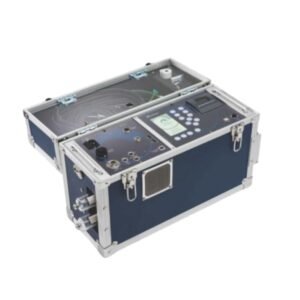
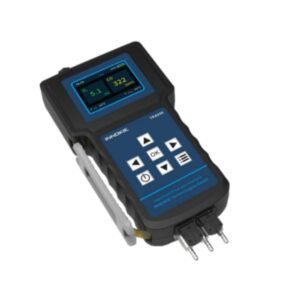
The TPM500 Portable Hygrometer adopts the electrolytic moisture measurement method. When the sample gas flows through the sensor, water molecules are absorbed by the P₂O₅ film layer and electrolyzed into H₂ and O₂, generating an electrolytic current. When absorption and electrolysis reach equilibrium, the magnitude of the electrolytic current is proportional to the moisture content in the sample gas.
Therefore, the moisture content in the sample gas can be determined by measuring the current.
This principle is used to measure trace moisture in gases such as N₂, He, Ar, Xe, O₂, CH₄, H₂, C₂H₂, C₂F₄, and SF₆. It is particularly suitable for measuring trace moisture in numerous gases including CO, CO₂, R23, and R13, except for gases that react chemically with phosphoric acid.
Application Fields
The TPM500 Portable Hygrometer is mainly used for the accurate detection of trace moisture in gases such as pipeline gas, feed gas, and product gas at industrial sites.It is also suitable for the detection of trace moisture in various other gases that do not damage the P₂O₅ coating and do not cause polymerization reactions on the electrodes.
It is widely applied in the accurate detection of trace moisture content in non-corrosive or weakly corrosive gases in chemical industries such as polysilicon, petrochemicals, biopharmaceuticals, and food processing.
Key Features
- Portable chassis, small in size and light in weight.
- 5.0-inch color touch screen, enabling intelligent and convenient operation.
- Front-mounted filtration for gas source purification and interference elimination.
- Gas-electric separation design for enhanced safety of personnel and equipment.
- Multi-unit display.
- Based on the principle of Faraday’s electrolysis method, a unique double-helix electrolytic cell has been developed.
Combined with a specially formulated electrolytic coating solution, it enables complete electrolysis and absorption of moisture as well as rapid response of test indicators. - Unique P₂O₅ film adhesion technology ensures uniform and firm adhesion of the electrolyte without loss, leading to a long service life.